Résumé rapide
- Les aimants en néodyme possèdent toujours un pôle nord et un pôle sud, mais c'est le sens de magnétisation (axial ou diamétral) qui détermine l'emplacement de ces pôles.
- Si vous utilisez une orientation des pôles inadaptée à votre projet, cela peut entraîner un échec total : vérifiez toujours le sens de magnétisation avant le montage.
- Identifiez facilement les pôles à l'aide d'un compas, de la méthode de suspension ou d'un aimant de référence. Évitez toute exposition à une température supérieure à 80 °C ainsi que les chocs physiques afin de prévenir toute démagnétisation ou casse.
Vous est-il déjà arrivé de prendre un aimant en néodyme et de vous demander quel était le bon côté ?
Peut-être êtes-vous en train de réaliser un projet de bricolage. Ou de fabriquer une pince magnétique pour votre atelier. Ou encore d'essayer de comprendre pourquoi deux aimants que vous venez d'acheter s'attirent parfaitement… alors que deux autres refusent de coopérer.
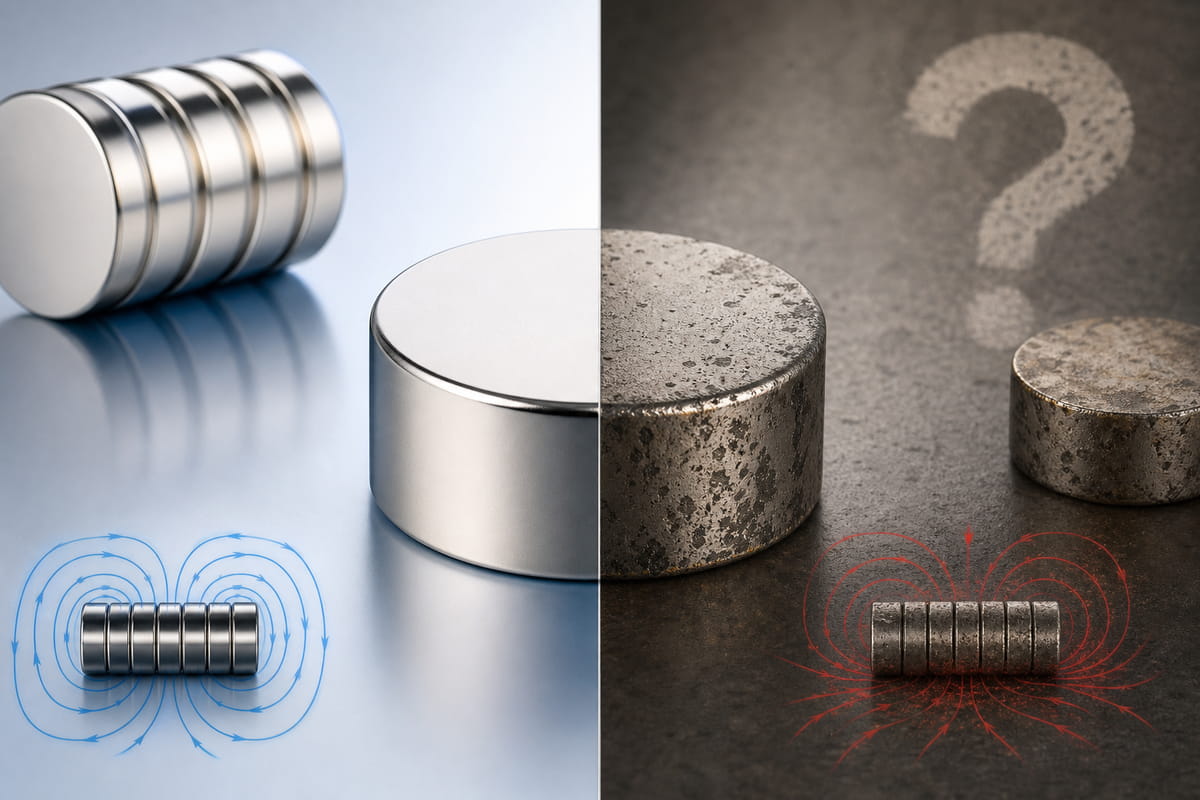
Les aimants en néodyme ont-ils un pôle nord et un pôle sud ? Oui, tout à fait. Comme tous les aimants permanents de la planète, les aimants en néodyme possèdent toujours à la fois un pôle nord ET un pôle sud. Il n’existe pas d’aimant unipolaire.
Mais contrairement aux simples aimants en barre avec lesquels vous jouiez en cours de sciences, les aimants en néodyme peuvent être magnétisés de différentes manières. Et cela change complètement la façon dont on les utilise.
Dans cet article, en tant que professionnel fabricant d'aimants en néodyme, je vais vous l'expliquer en détail.
Comment fonctionnent réellement les pôles magnétiques ?
Avant d'aborder les aspects spécifiques au néodyme, voyons d'abord les bases.
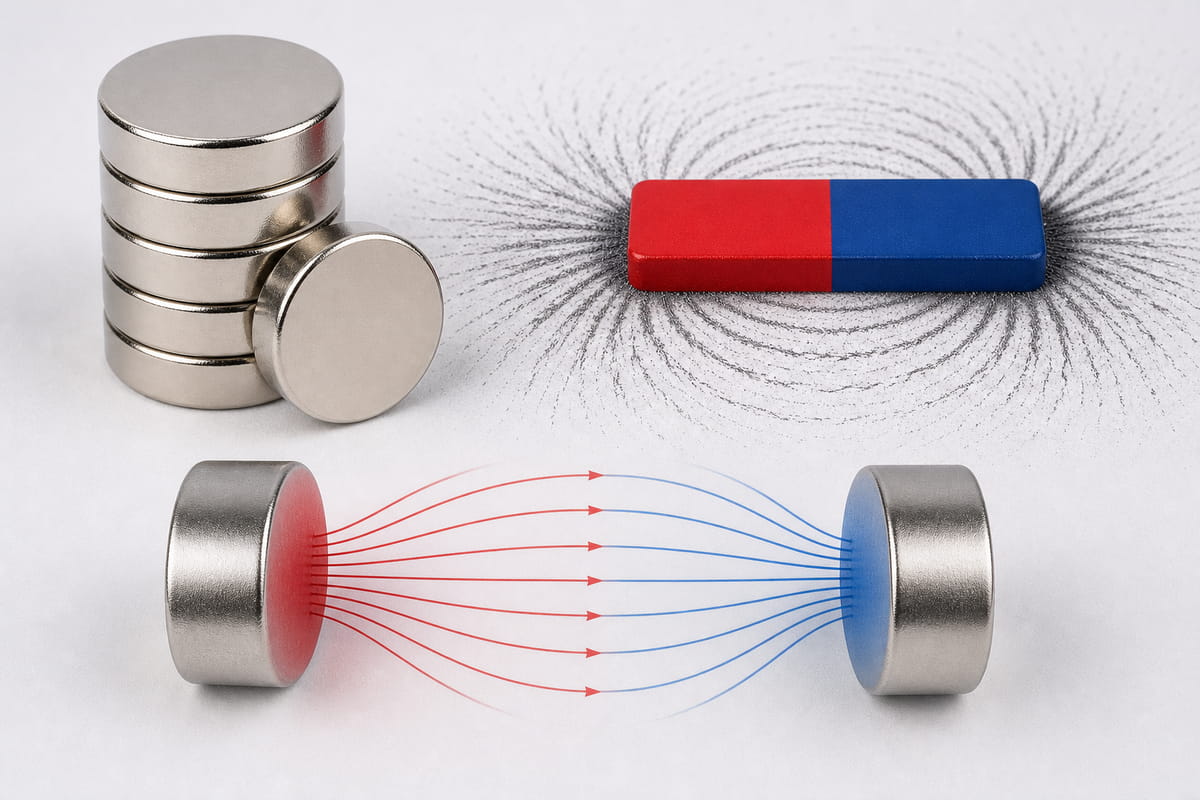
Chaque aimant génère un champ magnétique invisible. Ce champ comporte deux extrémités, appelées “ pôles ”. L'un est appelé pôle Nord et l'autre pôle Sud.
Les contraires s'attirent. Le Nord est attiré par le Sud.
Les affinités se repoussent. Le Nord s'éloigne du Nord. Le Sud s'éloigne du Sud.
C'est simple, non ?
Mais voici quelque chose dont la plupart des gens ne se rendent pas compte :
Si vous prenez un aimant en néodyme et que vous le cassez en deux… chaque morceau devient instantanément un NOUVEL aimant doté de ses PROPRES pôles nord et sud.
Tu as encore cassé ces morceaux ? C'est toujours la même histoire.
Vous pouvez continuer jusqu’à ce que les morceaux soient microscopiques. Chacun d’entre eux possédera toujours ses deux pôles.
Les scientifiques n'ont jamais découvert de monopôle magnétique. Et d'après tout ce que nous savons en physique, vous n'en trouverez probablement pas de sitôt.
En résumé ? Tout aimant en néodyme, quelles que soient sa taille, sa forme ou sa qualité, possède deux pôles.
Pourquoi est-ce important pour vos projets ?
J'ai discuté avec des centaines de personnes qui ont commis la même erreur.
Ils achètent un aimant disque en néodyme. Ils partent du principe que les pôles se trouvent sur les faces planes. Ils sont alors perplexes lorsque l'aimant n'adhère pas comme ils s'y attendaient.
Voici pourquoi cela se produit :
Tous les aimants en néodyme ne sont pas aimantés de la même manière.
Le sens de magnétisation dépend entièrement du mode de fabrication de l'aimant. Et si vous ne connaissez pas ce sens, vous travaillez en quelque sorte à l'aveuglette.
Je vais vous montrer ce que je veux dire.
Magnétisation axiale et diamétrale
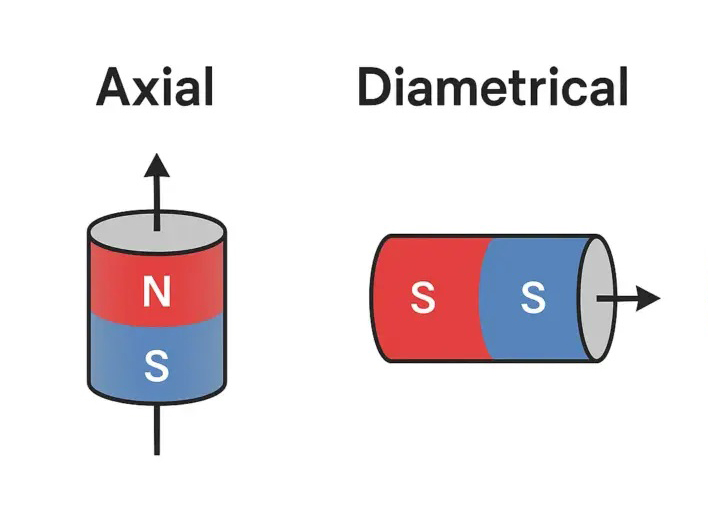
Pour les aimants en forme de disque et de cylindre, il existe deux options principales de magnétisation :
Magnétisé axialement – Les pôles nord et sud se trouvent sur les grandes faces planes. C'est ce à quoi s'attendent la plupart des gens. Ces aimants fonctionnent mieux lorsqu'une face plane est en contact avec une autre face plane.
Magnétisation diamétrale – Les pôles se trouvent sur les côtés arrondis. L'aimant attire ou repousse donc par sa surface courbe, et non par ses extrémités plates.
Voici un exemple concret :
Imaginons que vous achetiez un cylindre à magnétisation diamétrale pour une application de capteur magnétique. Si vous essayez d’utiliser les extrémités plates comme points de contact, cela ne fonctionnera pas. Le champ magnétique n’est pas orienté dans cette direction.
J'ai vu des ingénieurs passer des heures à déboguer ce problème précis.
Conseil de pro : Vérifiez toujours le sens de magnétisation avant de concevoir votre projet. Cela vous évitera bien des maux de tête par la suite.
Comment les aimants en bloc gèrent la polarité
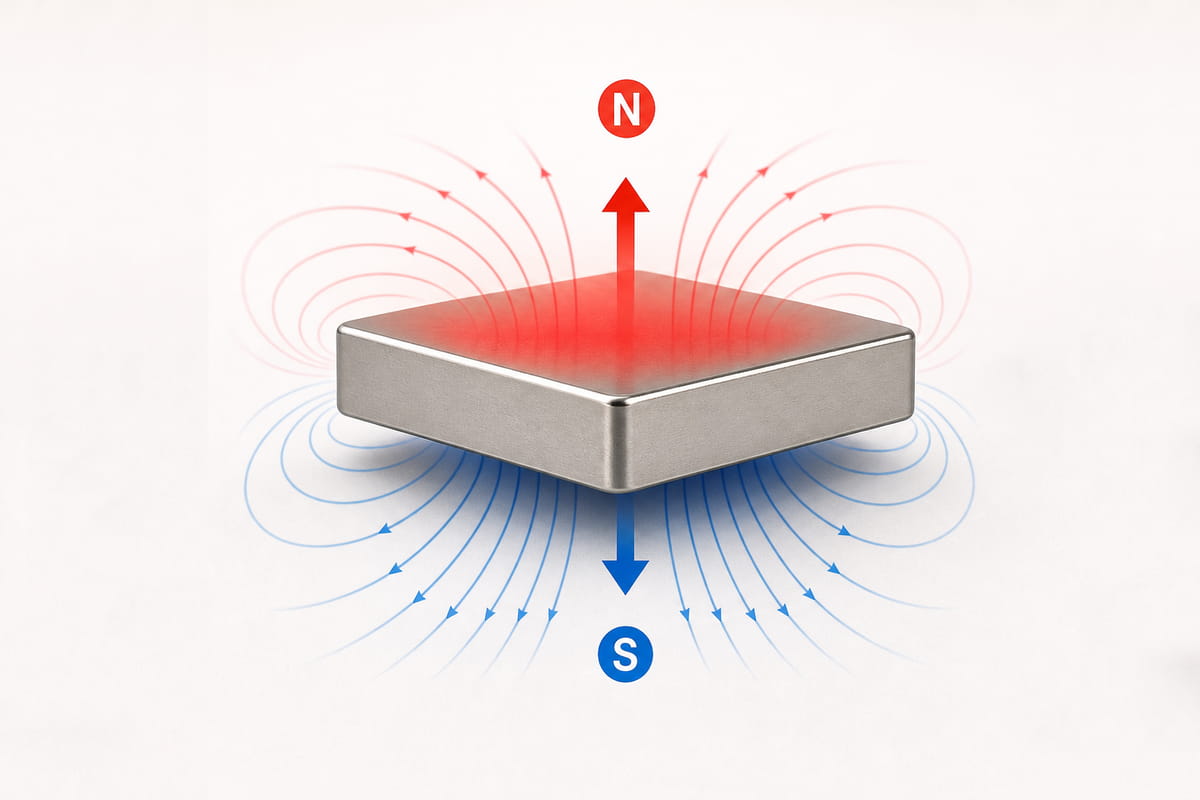
Les aimants en bloc obéissent à une règle différente.
Les fabricants définissent les dimensions des blocs magnétiques en indiquant la longueur, la largeur et l'épaisseur. Et voici l'élément clé :
L'épaisseur correspond TOUJOURS au sens de l'aimantation.
Cela signifie que les pôles Nord et Sud se trouvent sur les deux plus grandes faces, celles qui sont séparées par l'épaisseur mesurée.
Jetez un œil à ces exemples :
Exemple A : Un bloc mesurant 3/4 x 1/2 x 1/4 de pouce. La magnétisation s'étend sur la dimension de 1/4 de pouce. Les pôles se trouvent donc sur les faces de 3/4 x 1/2.
Exemple B : Un bloc mesurant 3/8 x 1/4 x 1 pouce. Ici, l'épaisseur correspond à la plus grande dimension (1 pouce). Les pôles se trouvent donc sur les faces de 3/8 x 1/4.
Vous voyez le schéma ?
Le dernier chiffre de la mesure correspond TOUJOURS à l'axe de magnétisation.
C'est l'un de ces détails qui passent facilement inaperçus. Mais une fois que vous le saurez, vous ne serez plus jamais dans le doute.
Qu'en est-il des aimants en anneau et en sphère ?
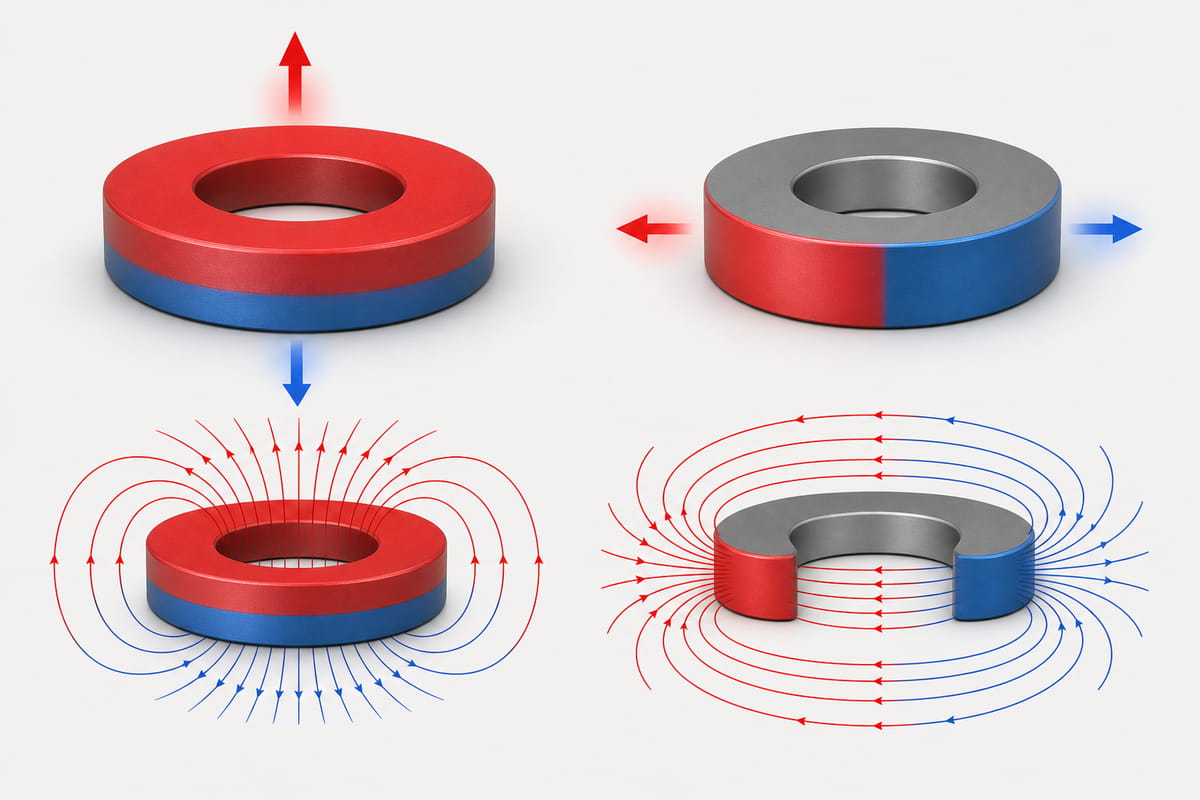
Les aimants annulaires fonctionnent exactement comme les aimants en disque. Vous avez deux options :
- Magnétisé axialement – Poteaux sur les surfaces planes
- Magnétisés de manière diamétralement opposée – Poteaux sur les côtés arrondis
Les aimants sphériques sont plus simples.
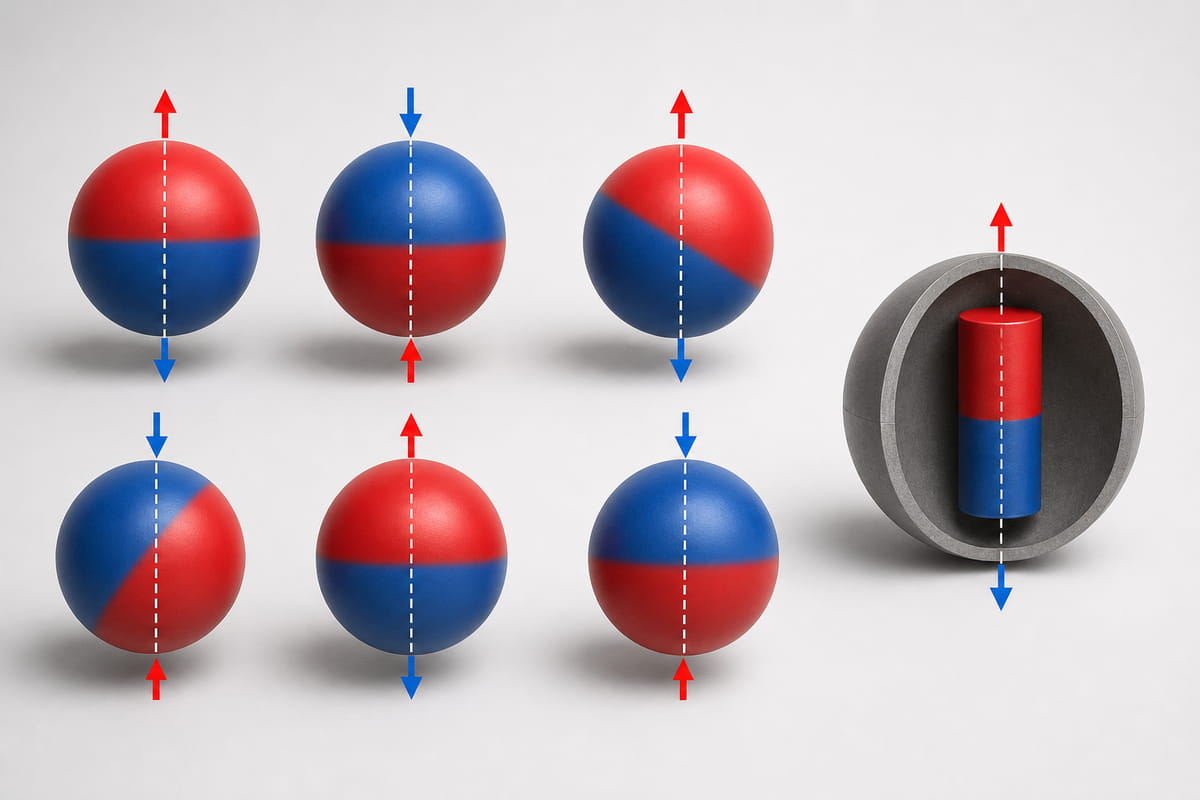
Elles ne peuvent être magnétisées QUE dans le sens axial. Les pôles sont donc toujours opposés l'un à l'autre et passent par le centre de la sphère.
Pas de surprise là-dessus.
C'est avec les aimants en arc que les choses se compliquent. Ils offrent quatre options de magnétisation :
- Sur toute la circonférence
- Sur toute l'épaisseur
- Au nord, sur la face extérieure
- Au sud, sur la face extérieure
Si vous utilisez des aimants en arc, vous devrez vérifier attentivement les caractéristiques techniques spécifiques à votre produit.
3 façons de repérer les pôles Nord et Sud
Vous avez donc un aimant en néodyme. Vous savez qu'il possède deux pôles. Mais comment distinguer les deux côtés ?
Il ne suffit pas de les regarder. Les aimants en néodyme ne comportent aucun repère visuel (à moins que vous ne les ajoutiez vous-même).
Voici trois méthodes que j'utilise personnellement :
Méthode #1 : Utiliser une boussole
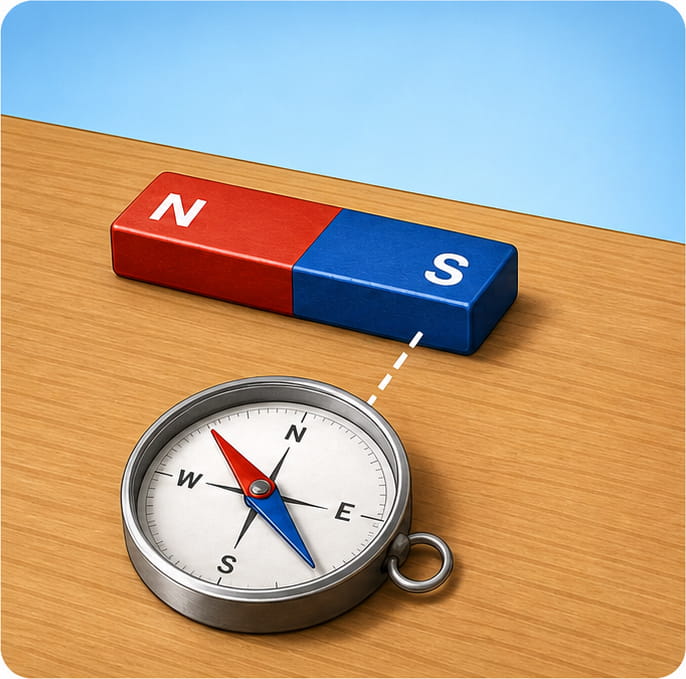
C'est ma méthode préférée. Elle est simple, précise, et presque tout le monde a une boussole qui traîne quelque part.
Placez votre aimant sur une surface plane. Approchez une boussole d'un de ses côtés.
Voici ce qui se passe : L'extrémité nord de l'aiguille de la boussole pointe vers le pôle sud de l'aimant. Et l'extrémité sud de l'aiguille pointe vers le pôle nord de l'aimant.
Pourquoi ? Parce que les contraires s'attirent. L'aiguille de la boussole est elle-même un petit aimant.
Il suffit de regarder quelle extrémité de l'aiguille pointe vers quel côté de votre aimant. Cela vous dit tout ce que vous devez savoir.
Méthode #2 : la méthode de la suspension

Vous n'avez pas de boussole ? Pas de problème.
Attachez un bout de fil au milieu de votre aimant. Tenez le fil et laissez l'aimant pendre librement.
L'aimant s'alignera naturellement avec le champ magnétique terrestre. L'extrémité qui pointe vers le nord géographique correspond au pôle nord de votre aimant. L'extrémité opposée correspond au pôle sud.
Cette méthode demande un peu de patience : l'aimant a besoin d'un peu de temps pour cesser de se balancer. Mais ça marche à merveille.
Méthode #3 : le test de répulsion
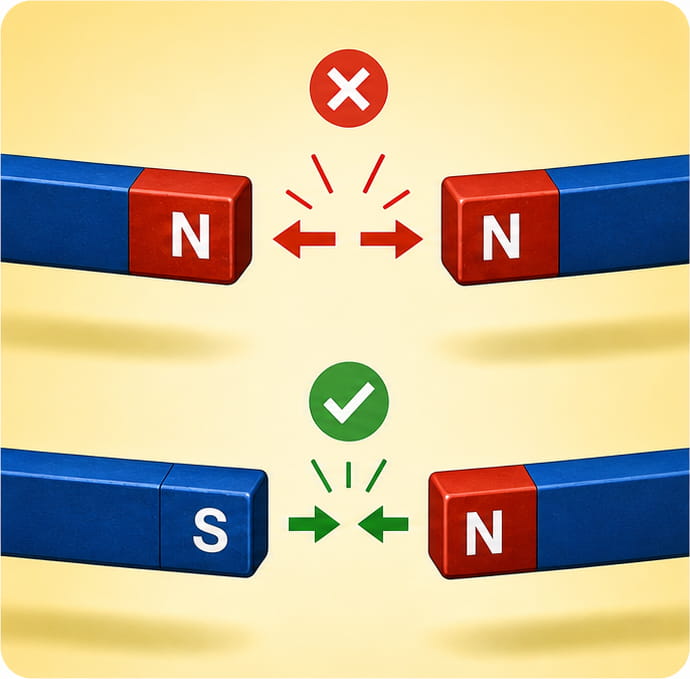
Vous avez un aimant dont vous connaissez la polarité ? Parfait.
Approchez l'aimant inconnu de votre aimant de référence.
Et s'ils se défendent ? Les poteaux sont identiques.
Est-ce qu'ils attirent ? Les pôles sont opposés.
C'est la méthode la plus rapide si vous disposez déjà d'un aimant de référence marqué. Attention toutefois : les aimants en néodyme s'attirent avec une force considérable. J'ai déjà vu des doigts se faire écraser et des bords s'ébrécher.
Idées reçues courantes sur les pôles en néodyme
J'entends sans cesse les mêmes idées reçues. Permettez-moi d'en dissiper quelques-unes.
Mythe #1 : “ La face la plus large correspond toujours à la face polaire. ”
Non. Sur les disques à magnétisation diamétrale, les pôles se trouvent sur les côtés ARRONDIS. Les faces plates ne présentent qu’un champ magnétique très faible.
Mythe #2 : “ On peut bloquer le magnétisme d'un seul côté. ”
On ne peut pas “ désactiver ” un pôle d’un aimant brut. Le champ magnétique s’écoule toujours du nord vers le sud. On peut le rediriger à l’aide d’un récipient en acier (c’est ainsi que fonctionnent les aimants en pot), mais on ne peut pas éliminer complètement un pôle.
Mythe #3 : “ Les aimants perdent de leur puissance avec le temps. ”
Dans des conditions normales, les aimants en néodyme ne perdent que moins de 1% de leur magnétisme tous les 100 ans. C'est pratiquement permanent.
Les véritables ennemis sont :
- Température supérieure à 80 °C (176 °F) pour les nuances standard
- Chocs physiques (ils sont fragiles)
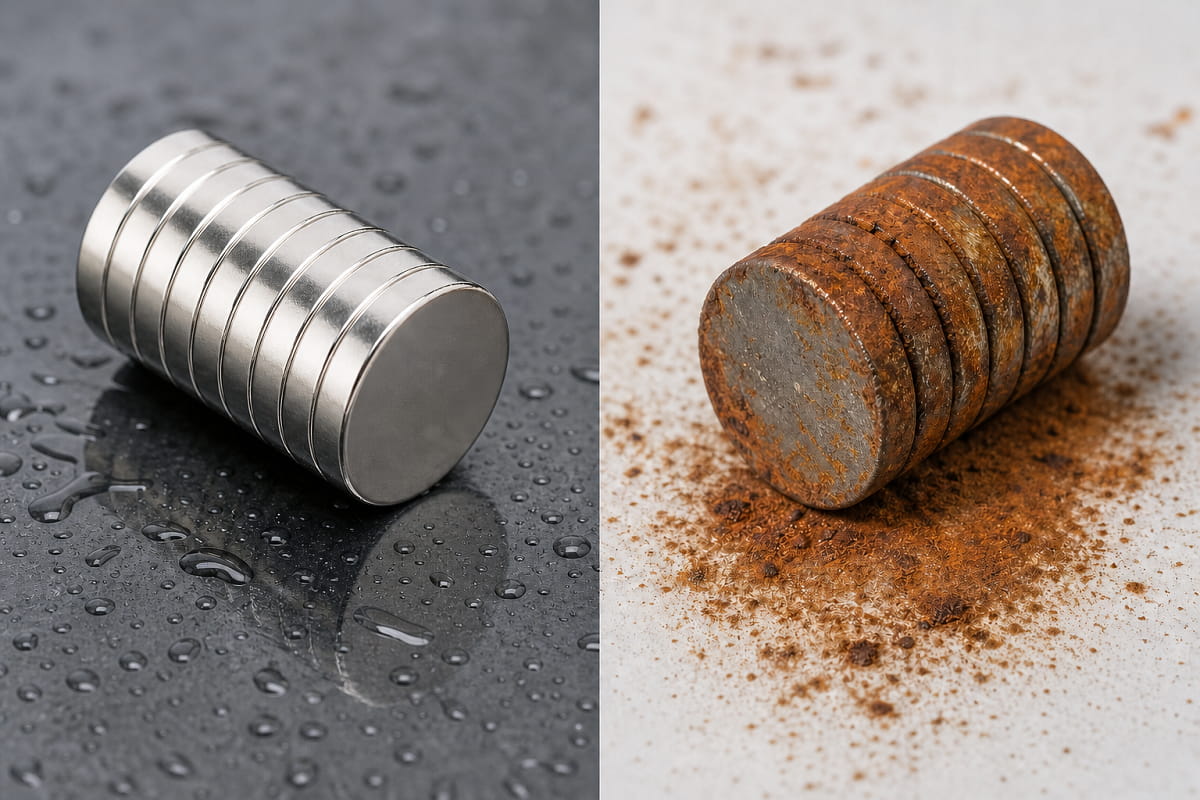
- Corrosion (utilisez toujours des aimants revêtus dans les environnements humides)
Applications concrètes où la polarité a son importance
Comprendre la polarité n'est pas seulement une question théorique. Cela a une incidence directe sur la manière dont vous utilisez ces aimants.
Capteurs magnétiques Cela dépend de l'orientation précise de la polarité. Si vous installez à l'envers un cylindre dont les aimants sont diamétralement opposés, votre capteur ne se déclenchera pas.
Accouplements magnétiques nécessitent une disposition alternée des pôles pour transmettre le couple. Si la polarité est inversée, l'accouplement ne tournera pas.
Fermetures magnétiques (comme sur les étuis pour iPad) utilisent des orientations spécifiques des pôles pour créer ce “ clic ” très agréable lorsque le couvercle se referme.
Moteurs électriques dépendent de champs magnétiques soigneusement agencés. Les performances globales du moteur dépendent d'une polarité correcte.
J'ai vu aussi bien des amateurs que des professionnels commettre ces erreurs. La solution est toujours la même :
Vérifiez le sens de magnétisation. Marquez les pôles. Vérifiez une nouvelle fois avant le montage.
Comment la température influence les pôles magnétiques
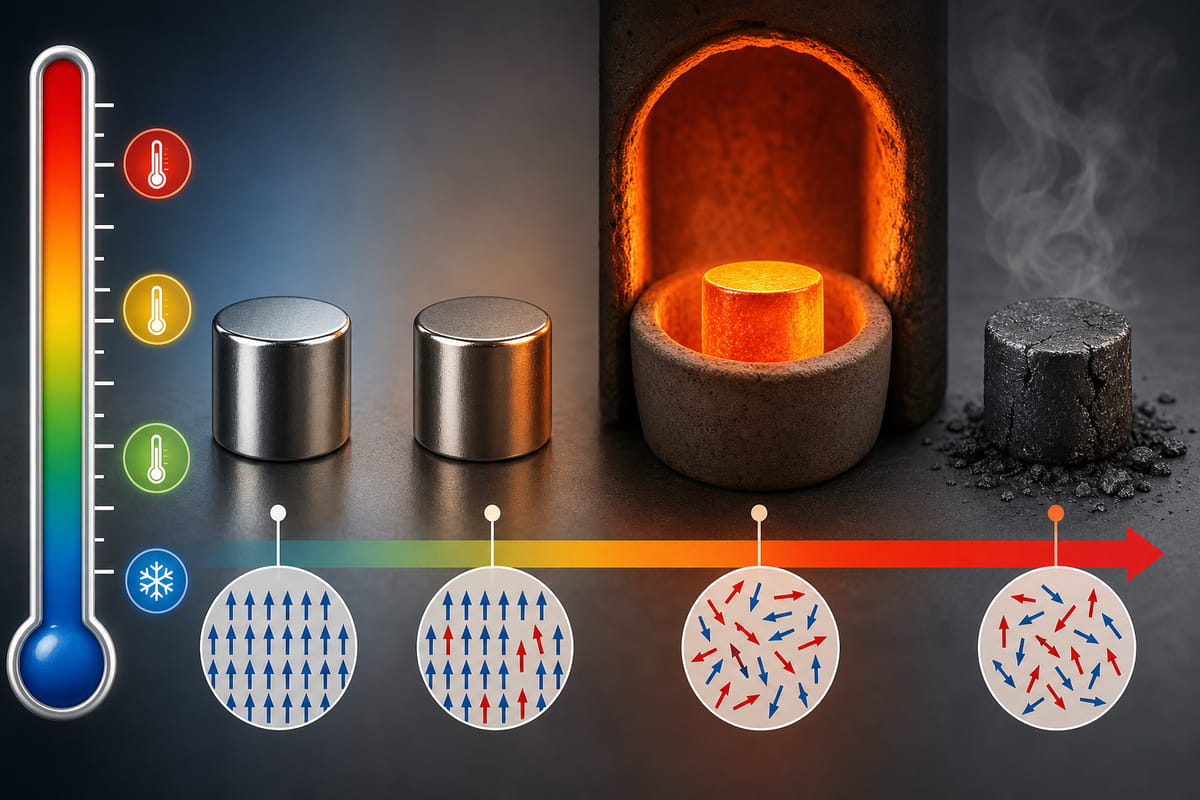
Les aimants en néodyme peuvent perdre leur magnétisme s'ils sont soumis à une chaleur excessive. Les aimants standard de classe N commencent à perdre de leur puissance à partir d'environ 80 °C (176 °F).
Mais les pôles magnétiques eux-mêmes ne “ se déplacent ” pas et ne s'inversent pas. C'est le matériau qui se démagnétise. Les domaines alignés qui créent les pôles se dispersent de manière aléatoire.
Le résultat ? Un aimant bien moins puissant, mais qui possède toujours un pôle nord et un pôle sud.
Si vous avez besoin de performances à haute température, optez pour des nuances spécialisées :
- NxxM : 100 °C (212 °F)
- NxxH : 120 °C (248 °F)
- NxxSH : 150 °C (302 °F)
- NxxUH : 180 °C (356 °F)
- NxxEH : 200 °C (392 °F)
Chaque niveau supérieur vous offre une plus grande marge thermique. Mais cela vous coûtera plus cher.
Pour conclure
Les aimants en néodyme ont-ils un pôle nord et un pôle sud ? Oui, absolument tous. C'est exactement ainsi que fonctionnent les aimants permanents.
Mais la vraie question n'est pas de savoir s'ils ont des poteaux. C'est plutôt où où se trouvent ces poteaux.
Les disques magnétisés axialement présentent des pôles sur leurs faces planes. Les disques magnétisés diamétralement présentent des pôles sur leurs côtés arrondis. Les blocs sont magnétisés sur toute leur épaisseur (dernière mesure indiquée dans les dimensions). Les anneaux et les sphères obéissent à des règles similaires.
Une fois que l'on a compris le sens de la magnétisation, tout le reste s'explique de lui-même.
Vous pouvez déterminer les pôles à l'aide d'une boussole, de la méthode de suspension ou d'un aimant de référence. Vous pouvez choisir la puissance adaptée à vos besoins en matière de température. Et vous pouvez utiliser ces aimants exceptionnels en toute sécurité et avec efficacité.
Allez donc vérifier la polarité des aimants que vous utilisez. Vous pourriez être surpris par ce que vous allez découvrir.
Conseil de pro : Procurez-vous un identifiant de pôles magnétiques à petit prix. Il clignote en différentes couleurs pour indiquer le nord et le sud. C’est le meilleur $15 que vous puissiez acheter pour votre établi.